
Johnny Panarese

Johnny Panarese’s team saved his life.
Johnny plays baseball for St. Olaf College. A dedicated athlete, he takes his health seriously: no drinking, smoking, energy drinks or coffee.
Johnny was finishing a weight room workout with the team when he suddenly went into cardiac arrest.
He was 19 years old.
Coach John Waters started CPR and called 911. St. Olaf EMTs Miles Greenberg and Camden Cook arrived within minutes, as did campus Safety Officers Ben Grisim and Devin Klimek. The team used the gym defibrillator to restart Johnny’s heart.
NH+C paramedics Jon Hunter and Kianna Rowekamp took Johnny by ambulance to Northfield Hospital, where he went into cardiac arrest a second time. Physician Maggie Storlie, MD and team defibrillated Johnny’s heart, then intubated, sedated, and transferred him to Abbott Northwestern Hospital, NH+C’s partner for cardiac care.
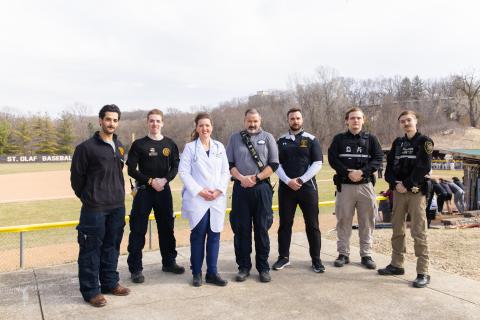
“The ED doctor recognized the severity of the situation, acted swiftly and precisely to get him to the heart ICU at Abbott,” says Johnny’s mom Laura. “The measures taken at Northfield Emergency Room were impeccable, and put our son in the best possible position to recover.”
At Abbott, Johnny was kept in a coma and went through a cooling process to protect his brain. “The doctors could not guarantee us he would wake up and if he did what his brain function would be like,” Laura recalls.
Johnny did wake up. MRIs and CT scans showed a perfectly healthy heart. He cleared all physical and cognitive tests, including speech pathology and occupational therapy.
His care team expected Johnny would be in ICU for five days and at Abbott for three weeks. After just five days, Johnny was healthy enough to go home.
“I was confident when I walked out of the hospital that day,” Johnny says. “They basically said, ‘Just live a normal life from here on out.’”
Two weeks later, he was back at school. Johnny finished the semester on time, and made the Dean’s List.
“The survival rate for this is very low. A full recovery is incredible,” Laura says. “He’s a walking miracle.”
Cardiologists at Abbott Northwestern implanted a cardioverter defibrillator in Johnny’s chest, an EV-ICD that monitors his heart activity constantly, and can act as defibrillator if needed and treat abnormal heart rhythms with anti-tachycardia pacing – similar to a pacemaker.
“It might never happen again, but if it does, he’s got a paramedic in his chest,” Laura says. The device is under his left lateral muscle, away from his throwing arm, with his heart lead under his sternum. His device electronically transmits to a monitor in Johnny’s dorm room; it collects data daily, and sends the data to the clinic team at Abbott Northwestern. It flags any abnormal activity, like an odd arrhythmia, and alerts the care team to contact Johnny and check on him.
Some of Johnny’s follow up care takes place at NH+C’s Northfield Clinic, where device nurses from Allina’s Minneapolis Heart Institute give Johnny – and his device – periodic checkups.
“The first check was important because when I started working out, they had over 70 episodes registered as if something was wrong,” Johnny says. The team needed to set a baseline that matched his workout schedule and intensity. They were able to pinpoint moments in the data where Johnny heart rate rose because he was exerting himself: “They could see every few days when I had my workouts.” Now, the monitoring baseline is set to match his activity level as an athlete.
“The medical response every step of the way was flawless,” Laura says. “The ICU doctor at Abbott said that the measures from St. Olaf, NH+C’s Emergency Services and the hospital’s Emergency Department were exemplary, and their response could not have been better.”
The coordination between St. Olaf, NH+C and Abbott Northwestern/Minneapolis Heart Institute shows the strength of partnerships that NH+C nurtures to make sure patients get the level of care they need, right when they need it . . . however extreme the situation.
“Everyone who was a part of that process did the right things, and they took it seriously,” Johnny says. “And that led to my success today.”
“The care, compassion and expertise every step of the way is overwhelming,” Laura adds. “When you see that many people involved, it feels like there’s so much room for error. But everyone performed so stupendously.
“This team gave our son the best possible chance to survive and recover. We will forever be grateful to the entire team for taking such tremendous care of our son.”
Two NH+C nurses called Abbott to check on Johnny, Laura recalls. His care team – and his baseball team, and St. Olaf staff – made sure he was never alone. “The community held us at every turn,” Laura says. “That level of care and concern, especially when we were so far away, was overwhelmingly positive. It’s important to them too, to be able to see this great outcome.”
Johnny’s especially grateful for his baseball team. “We're very tight knit, so anything that happens to someone, we all feel it deeply. My team is definitely a driving factor to get me back to where I am today. The people around you are very important.”
Genetic testing after Johnny’s recovery showed a rare genetic inheritance that may be a possible cause. (Johnny’s dad and sister tested positive for that rare gene too.) Either way, Johnny’s treatment plan is the same. And his family now has knowledge to prevent this from happening to other family members.
“The future feels pretty normal,” Johnny says. “There are new complications with this, things that I'll have to be careful of, or look forward to. But overall, I'm still looking at my future the same way I was before the incident.”
And keeping his team close.
_______________________________________________________________________________________________
Cardiac arrythmia: Symptoms and risks
Arrythmia is an irregular heartbeat. Changes in heart tissue and activity, or in the heart’s electrical impulses, may make the heart beat too fast, too slowly, or erratically. Untreated arrythmia can cause heart attack or stroke.
Symptoms include:
A “fluttering” sensation in the chest or neck
Rapid heartbeat or pounding in the chest
Fatigue or weakness
Dizziness or lightheadedness
Fainting or near-fainting spells
Shortness of breath and anxiety
Chest pain or pressure
Alternating fast and slow heart rate
Sweating
If you have chest pain or pressure, it may be a heart attack. Call 911 immediately.
An estimated 1.5% to 5% of the general population have arrhythmias. Many have no symptoms.
Some ways to reduce the risk of arrythmia include:
Reduce high blood pressure
Control cholesterol levels
Lose excess weight
Eat a heart-healthy diet
Do regular physical activity
Don’t smoke
Drink alcohol in moderation
Sources: American Heart Association; National Institutes of Health